
Energy crisis

Disclaimer: If you are reading this and dealing with ANY health related problems I am NOT recommending you take the same unconventional approach as I have in my battle with Crohn’s disease. Any changes you wish to make in your care plans should be done in partnership with the team of qualified healthcare providers who treat you.
How am I continuing to improve my health?
Now that I have control of my GI symptoms through the foods I eat you might think that I have “arrived” in my journey with IBD, but if you’ve kept up with my story you’ll know that I still have a wide variety of other symptoms that I deal with on a daily basis. I’ve detailed several of these issues in a post on seasonal factors but as a quick recap I deal with low energy, brain fog, anxiety and unexplained weight loss at various times of the year.
Yes, surprisingly I’ve seen weight loss during periods of peak pollen even with no visible GI distress. In the last few years I’ve lost as much as 9 pounds in just 3 weeks even while keeping my diet fixed. I also find myself needing to lay down and rest more often during peak pollen.
I live in an area with some of the worst pollen extremes in the country and it is almost like my body can’t keep up with the demands being put upon it - it’s an energy crisis!
There are two versions of me: 1) The Nathan that for the most part thrives in the winter months with minimal symptoms and plenty of energy and 2) the Nathan that wants to go hibernate until next year’s winter. (Ha!)
What options do I have to mitigate my energy crisis?
Initially this post was going to be focused around supplementation. After spending three years on an elimination diet where I tested over 100 ingredients I’ve spent the last four years testing various supplements in an attempt to further improve my overall health. But even after four years of supplementation I feel like I’m only scratching the surface.
So for the sake of this blog post I’m going to focus my attention on what diet related levers I pull throughout the year to manage my energy levels and my weight - not specific supplementation.
What have I found helpful in mitigating my energy crisis?
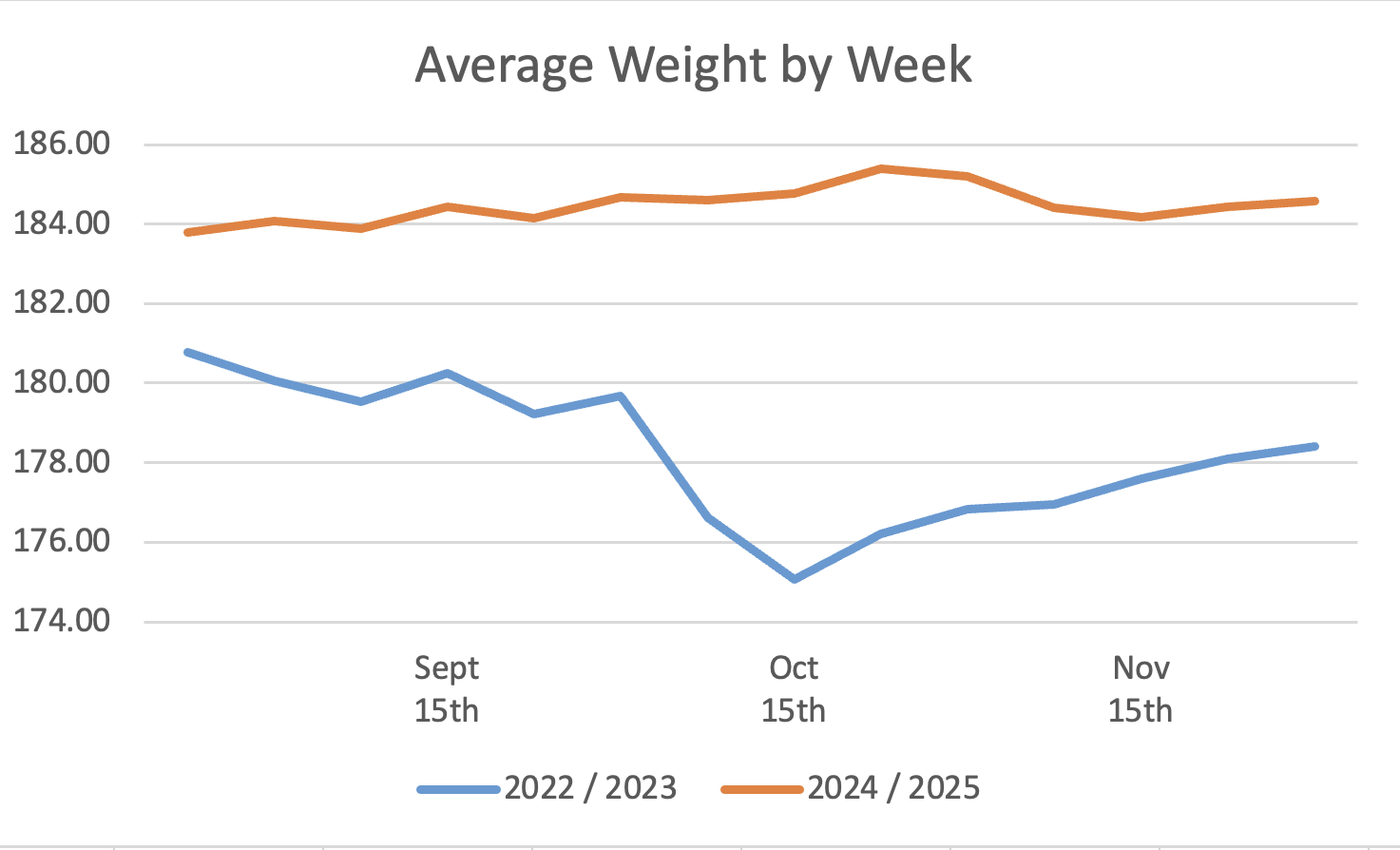
You can see from the graph below that I lost weight in October 2022 / 2023 but I kept my weight stable over the same period in 2024 and 2025.
For years my diet has been static. I eat the same meal at both lunch and dinner every day. I’ve also ate the same breakfast for years. While this might get really boring really fast I do this because I have a large list of trigger ingredients to avoid AND as strange as this sounds I intentionally choose to keep my diet as consistent as possible. Sure I eat cheat meals from time to time but my goal since I started my elimination diet in 2019 has been to minimize variables to better see the outcome of health experiments.
In 2022 when I lost 7 pounds over 4 weeks and again when I lost 9 pounds over the same four weeks in 2023 I was able to see a pattern forming that I wanted to correct however my concern was never really about my weight but more of how ragweed drained my body as a whole.
Here are a few journal entries for additional context on how I felt during peak ragweed:
“My body feels weak, tired, and heavy. I’m ready for either some rain or the next few weeks to be over… and the forecast isn’t calling for any rain.” September 15th, 2022
“I look pale and I’m still not gaining weight. I’ve also been more sore than usual after my workouts even though I’ve dropped my targets. This is supposed to be the month where things start turning around but six days in and I’m not seeing improvements yet.” October 6th, 2022
“Today I left work early and laid down for at least an hour. At work the simplest things were pushing my anxiety to overload. I am ready for ragweed to be gone.” September 13th, 2023
In fact I kept up with my tiredness levels over those four years as well. The graph below shows my exhaustion levels were lower in 2024 and 2025 than they were in 2022 / 2023. Note: The higher blue line shows I had more hours in the day where I was tired.
So what changed?
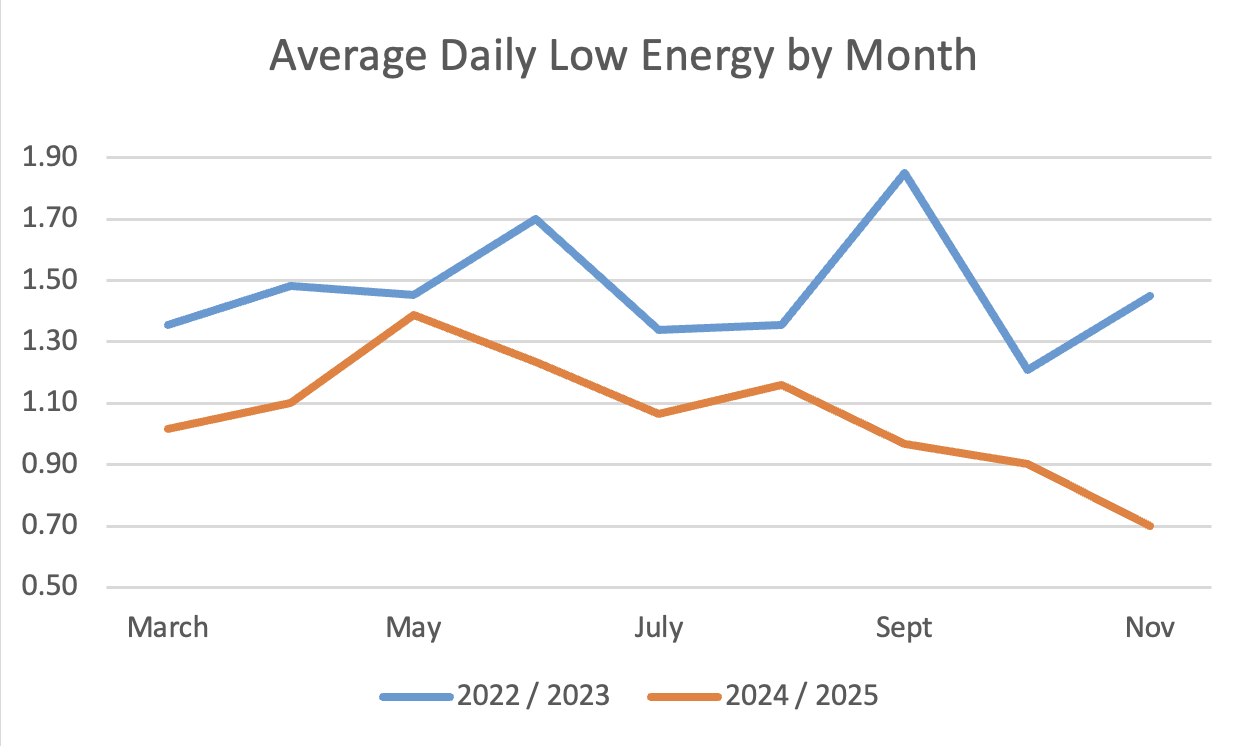
Well the short answer is… I was deliberate in eating more calories.
I know, I know, this is not a ground breaking concept but what has been important is to know what to expect and how to change things proactively to help my body better handle these external factors.
Where I live there are 4 distinct seasons. Each season affects my body progressively.
Winter has by far the lowest energy demands on my body as there is virtually little to no pollen during the winter months. I feel great during the winter! This is my desired “normal”.
As spring rolls in my body can feel the effects of tree pollen but largely it handles everything really well to start the year. My energy demands are slightly higher than they would be in the winter. All in all I feel really good in spring - maybe a bit worse during peak tree pollen but not awful.
By middle of the summer when grass pollen is at its highest my body really starts to feel the effects a bit more. I tend to become tired more easily in the afternoons and my energy requirements go up even more.
Lastly ragweed picks up in August and doesn’t really quit until October. Fall (by far) puts the highest level of stress on my body. Low energy, sleeplessness, and anxiety have all been higher during this period than other times of the year.
How can I use this knowledge to my advantage?
I am able to plan accordingly knowing that seasonal factors follow similar timelines every year. The process I’ve defined looks a little like this:
In the winter I have a baseline set of meals that I eat for breakfast, lunch, and dinner. I don’t need to snack quite as often and the meals I eat are lower carb. I consume the lowest amount of calories in the winter. I also only supplement as needed in the winter. (3 small meals a day)
In spring I eat one additional meal in the morning as a way to increase calories slightly. I snack a bit more as needed. I also begin to add some minor supplementation to my daily routine. (4 small meals a day)
By summer I’ll start doubling up on breakfast and add in additional carbs with dinner if needed to give me some extra energy. My supplementation is further increased during this period. I’ll drink an extra shot of espresso too. (5 small meals a day)
In fall I increase everything significantly. I’ll double up on dinner and include additional carbs as well. The fall is when I hit max calories, carbs, espresso, and supplementation. (5 meals - larger lunch and dinner)
At the end of ragweed season I have a taper period where my body goes from its highest energy demands (ragweed) to its lowest (winter) in just a few weeks. If I don’t taper during this period I’ll gain unnecessary weight and experience side effects from over supplementation (dehydration, etc.). This phase is just as important to my process as is increasing calorie intake through the year.
| Factor | Winter | Tree | Grass | Ragweed | Taper |
|---|---|---|---|---|---|
| Meals | 3 low carb meals | 4 balanced meals | 5 balanced meals | 5 higher carb meals | 4 balanced meals |
| Supplementation | As needed | Minor | Small increase | Largest increase | Minor |
All of this ensures I’m keeping my energy levels high when my body has greater demands while also giving my body a period of rest during periods it doesn’t need as much.
My routine has one more layer that makes it a bit more complex within each season. Since pollen ramps up and tapers off, I make minor tweaks to my routine based on if it is peak pollen or not. This means that I’ll eat and/or supplement a little more when there is more pollen in the air and less when pollen is lower or when it’s raining for an extended period of time. It is a lot of listening to my body and what it needs.
Everyone has different diets, different triggers, and different nutrient deficiencies. Every part of the world has different seasonal cycles as well. Hopefully this post presents the concept for how I think about my energy needs based on how seasonal factors in my area affect my body specifically. I hope my experiences help you think about seasonal factors in new ways even if you don’t deal with the same impacts that I do.
At some point I will probably share more of my journey with supplementation but there are several key things I’m learning:
- Getting my diet right has been significantly more important than supplementation in my personal journey
- Supplements can be very beneficial and I wholeheartedly believe supplementation will always be part of my life going forward however….
- Too much of any supplement can be a bad thing.
As I have more to share I'll keep you updated here. Best!


Now that I have control of my GI symptoms through the foods I eat you might think that I have “arrived” in my journey with IBD, but if you’ve kept up with my story you’ll know that I still have a wide variety of other symptoms that I deal with on a daily basis. I’ve detailed several of these issues in a post on seasonal factors but as a quick recap I deal with low energy, brain fog, anxiety and unexplained weight loss in various times of the year.